Showing posts with label Government and Governance. Show all posts

Monday, February 25, 2013

Bring A Bag Campaigns have to become widely implemented as entry to public events

Pictures on this post are by Ian Hall. 
Ian holds the copyright of these photographs. 
They are published here with his permission.

On Saturday night, Ian Hall and I were in Melbourne's eastern suburbs for a friend's wedding.  After the reception, somewhere about midnight, we went to bed setting the alarm for 3am.  You see, Gleaners, we wanted to get into the city to catch White Night which was operating from 7pm to 7am.  

No vehicular traffic was entering the Melbourne CBD but trams were running all night.  We drove in and parked in the university precinct and caught the No. 19 (North Coburg) tram into the CBD.  Even though the crowd numbers at that hour were well down on the quoted 300,000, the transformed city was a wonder to see.  Familiar buildings were transformed beyond what our daily imagination could have conjured up.  Creativity was released.  Music, performers, artists, craftspeople, puppeteers.

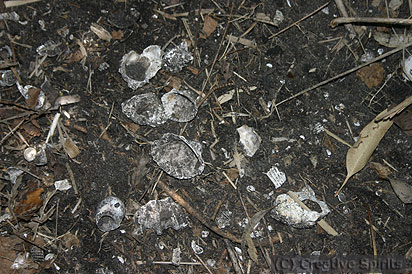
However, there was something very thoughtless and unattractive on what was left behind - massive quantities of rubbish and detritus.

The sort of demographic which flocked to White Night, I think, would have responded positively to a poll asking their attitude to matters environmental.  I am sure the majority of people would have been enthusiasts expressing great love and concern for their environment.  The major flaw is that love and concern was not demonstrated on the streets of the Melbourne CBD on Saturday night 23 February 2013.


I don't want to hold only the individuals comprising the crowd accountable.  The council of the City of Melbourne did not have its collective thinking cap on.  Did any of the leadership of the City of Melbourne consider the ramifications of 300,000 people coming to town - and a lot of them staying for at least 12 hours?!

Not to worry - that international corporate, SPOTLESS, was there to pick up the pieces. 

I suspect this rubbish might have remained unsorted and unrecycled and may well have been dumped into landfill.  

A possible solution?
  • What if all those who came into the CBD had to pass through checkpoints - entry only if you could produce two bags - one for recyclables and one for other stuff? 
  • What if large bin points were strategically located for people to dump their rubbish thoughtfully before they went home?  
  • What if the police - who, when we saw them, were standing around bored stiff - were empowered to issue on the spot fines for littering? 
  • And what if Spotless were only needed to pick up the dump bins regularly and take them to a spot at which they could be thoughtfully recycled or otherwise disposed?  
  • What if these massive CBD crowd scenes were to become admired gatherings for their environmental care? 
Our society, it seems to me, has not got past an out of sight, out of mind attitude to waste disposal.  We seem to think that if we clean it all up, take it away, dispose of it or dump it where we can't be reminded of it, we are acting appropriately.

Every item, no matter how small, that we waste, throw away, dispose of goes somewhere on our planet.  Waste does not dissolve or get eliminated simply because we cannot see it and have left where it used to be clean.  

Above all waste costs.  It costs at the front end where there seems to be little awareness of whether packaging is necessary or kept to a minimum.  When we purchase a product the waste is included in the price.  At the back end, the cost of cleaning, recycling, disposing, and even dumping has a price.  The price is included in the rates charges of local authorities which finds its way back into front end product costs.  

Shocking costs are often inflicted on individuals and families where it hurts the most - on their bodies through illness, and on the biggest financial investment of most families - their houses and lands. These, the worst costs, are often delayed like a time bomb.  Cranbourne residents were greatly shocked, inconvenienced, and out of pocket when their local municipality allowed their homes to be built on landfill.  

Technology does fix some things but not all things.  Recycling ability is being extended constantly - but it costs. Local Authorities, by and large, have not given up on dumping in landfill - and those cheap take-your-frig-away services when you buy a new refrigerator are often a guarantee of your frig with all its gases and chemicals being tipped into a landfill somewhere to become a hazard on time delay.

We have to ask our local council and our state and federal governments to become care-fully focussed on waste at every level and every part of our daily lives.
  1. What is the waste policy of your local council?
  2. What councillors on your local authority are interested in development and what councillors will lend a sympathetic ear to a conversation on waste, its cost, its disposal?
  3. Where is your waste currently going? Waste disposal does not end at the local council's Transfer Station.
  4. If your local council is currently using landfill, what are its plans for closing all landfill and finding other methods for waste disposal?
  5. How is your local council transferring its waste disposal costs to business, government, and landholders in your local authority area?
  6. If you live in a local authority with significant rural land holdings and an agricultural/pastoral economy, what are the local landholders doing?  They frequently have their own landfill in which all sorts of things can end up.  Yet with the constant expansion of our cities and suburbs, that land often ends up in the hands of the developers to become suburban housing and business development.  Again, another slowly ticking hazardous bomb that we can't get our heads around because we are under the illusion that we have plenty of space to place things out of sight and out of mind.
In all these considerations, we must consider the air that we breathe, the water that we drink, and the land that grows our food.  In short, a cavalier attitude to waste in which we chuck without thought can affect the basic elements of life on this plant - air, water, food.  We must become forces of stimulation and collaboration for those who govern us and who take on community responsibility.  We cannot force business and government to take on responsible, thought-full and care-full policies if we fail to take our own individual responsibility.

All this requires more thoughtful conversation 
matched by thoughtful actions 
than we are managing at the moment.  


Thursday, May 3, 2012

CANBERRA E-WASTE RECYCLING SCHEME DUE TO START 15 MAY 2012


GOOD NEWS OUT OF CANBERRA VIA COMPUTER WORLD
Canberra will be the first jurisdiction to dispose unwanted electronics under the incoming national e-waste recycling scheme.
Under the industry-run and -funded National Television and Computer Recycling Scheme, to be launched mid-2012, DHL Supply Chain — a government-approved administrator — will provide free pick-up of computers, hard drives, keyboards, printers and televisions from 15 May 2012.
The service will operate from Mugga Lane and Mitchell transfer stations in ACT seven days a week.
A spokesperson for the Department of Sustainability, Environment, Water, Population and Communities told Computerworld Australia that fellow administrators, the Australia and New Zealand Recycling Platform and E-Cycle Solutions will be required to provide recycling services to the ACT by the end of 2013.
The scheme aims to curb the increasing dumping of electronic waste in Australian landfills — expected to hit 181,000 tonnes by 2028 from 106,000 tonnes in 2008 — and boost the recycling rate for TVs and computers from 17 per cent in 2010 to 80 per cent by 2021.
It is also looking at reducing human and environmental exposure to hazardous e-waste materials such as bromine, lead, mercury and zinc, as well as meeting a material recovery of 90 per cent by 2015.
The scheme was established under the Product Stewardship (Televisions and Computers) Regulations 2011 legislation and is to be amended to align the products and product codes with the revised product codes used in import declarations.
An exposure draft of the Product Stewardship (Televisions and Computers) Amendment Regulation 2012 has been released for public comment until 17 May 2012.
The scheme is to be rolled out across the country by 31 December 2013.
Follow Diana Nguyen on Twitter: @diananguyen9
Follow Computerworld Australia on Twitter: @ComputerworldAU

Enhanced by Zemanta

Wednesday, April 18, 2012

Gold from garbage - some seem to be getting it right


Environment: Getting Gold From Garbage – 
How Some Are Making Waste A Resource
Source: European Commission
Published Tuesday, April 17, 2012 - 10:36


Top performing Member States have recycling rates of up to 70 % and bury virtually nothing, whilst others still landfill more than three-quarters of their waste. How have the best performers turned waste from a problem into a resource? A new report from the European Commission today explains that it is by combining economic instruments. A mix of landfilling and incineration taxes and bans, producer responsibility schemes and pay-as-you-throw prove to be the most effective tools in shifting waste streams to more sustainable paths.. If the EU is to meet the objectives set out in the Resource Efficiency Roadmap – zero landfilling, maximising recycling and reuse, and limiting energy recovery to non recyclable waste – these economic instruments will need to be introduced more widely across all Member States.

Environment Commissioner Janez Potočnik said: "Waste is too valuable to just throw away, and if you manage it right you can put that value back into the economy. Six Member States now combine virtually zero landfilling and high recycling rates. Not only do they exploit the value of the waste, they have created thriving industries and many jobs in the process. This report shows how they achieved it: by making prevention, reuse and recycling more economically attractive through a selection of economic instruments. We now have a common responsibility with the Member States and local authorities to ensure that these instruments are effectively used and spread across the EU. This is one of the central goals of the Resource Efficiency Roadmap."
Experience in the Member States shows that a combination of the following instruments is the best way to improve waste management:
Landfill and incineration taxes and/or bans – the results of the study are unequivocal: landfilling and incineration rates have decreased in countries where bans or taxes have driven up costs for landfilling and incineration.
"Pay-as-you-throw" schemes have proved very efficient in preventing waste generation and encouraging citizens to participate in separate waste collection.
Producer responsibility schemes have allowed several Member States to gather and redistribute the funds necessary to improve separate collection and recycling. But cost-efficiency and transparency vary greatly between Member States and between waste streams, so these schemes need careful planning and monitoring.
Significant differences between Member States
There are significant differences in waste management between Member States. According to a Report published by Eurostat on 27 March (see STAT/12/48), the most advanced six Member States - Belgium, Denmark, Germany, Austria, Sweden and The Netherlands - landfill less than 3 % of their municipal waste. At the other extreme, 9 Member States are still landfilling more than 75 % of their municipal waste. Recent statistics published by Eurostat show continuous progress in some new Member States, where recycling rates are increasing rapidly. Municipal waste generation has also decreased in several Member States probably due to the economic downturn.
Economic Instruments needed to reach EU objectives
Replicating these instruments in all Member States will be necessary if the EU is to meet the targets set out in its waste legislation and its targets for resource efficiency. This is why the possibility of making their use legally binding in some cases will be assessed in a 2014 review of EU waste targets. The Commission is also including sound waste management in conditions for receiving certain European funds (see IP/11/1159 and MEMO/11/663).
Waste is good business
Meanwhile the Commission is encouraging Member States to implement existing waste legislation more effectively. Waste management and recycling industries in the EU had a turnover of € 145 billion in 2008, representing around 2 million jobs. Full compliance with EU waste policy could create an additional extra 400 000 jobs within the EU and an extra annual turnover of € 42 billion (see IP/12/18). Improved waste management would contribute to achieving several objectives and targets of the Europe 2020 Strategy for smart sustainable and inclusive growth.
More information
The report and detailed results for each Member State:
ESTAT Report on municipal waste management:
STAT/12/48
Study on macroeconomic modelling of sustainable development and the links between the economy and the environment:


Enhanced by Zemanta

Sunday, January 15, 2012

Handling the garbage down Mexico way


Mexico City is twice the size of Melbourne. And it is having problem with its garbage.  The powers that be have recently closed one of the world's largest landfills.  This has brought about illegal dumping of garbage - by the garbage collectors themselves!

Now rubbish is no respecter of persons: the poor, the rich, the intellectuals, and the dumb-bums all make waste and have garbage to dispose of so rubbish is being dumped in some of the posher suburbs of MC.

And it is not only Mexico City that is having problems.  Bogota (with a population 2.5 times the size of Melbourne) and Buenos Aires (half the size of Melbourne) are having problems.  Read more about this here.

To find out what is happening on the continent of South America, please look at the document below. 

Monday, November 21, 2011

Acquisition and Disposal: the twin peaks of waste, dumping and disposal


This is the BIG QUESTION!
Has your local council satisfactorily resolved 
the Hard Rubbish/Hard Waste on the Footpath issue, yet?


Yarra City Council is home to many environmentally conscious citizens and they display this consciousness with some success at the ballot box. I am sure the Council would consider itself pro-active.

Generally speaking, Councils - and I can only speak from my Melbourne experience - have gone from something like twice-yearly general hard waste collections - put it on the footpath and they will come, between the stipulated dates. - to a "book it, put it on the footpath with a sticker, between the stipulated dates" system.  Councils have gone from a general zonal system to an individualised site specific system complete with mailout and printed sticker


I'm not sure how Councils expect this way of doing things to be cheaper and effective -
and there's a Councillor at Yarra who says it's certainly not cheaper.


To be fair, Councils are between a rock and a hard place on this issue....
  1. It makes sense to give householders regular opportunities to relieve themselves of large items of waste.  No system at all means back to the bad old days and ways - fridges in creeks, mattresses under bridges and so on.
  2. Under the zonal general pick-up system, Councils believed gleaners were an issue leaving footpaths messier than just the original site.
  3. Councils believed gleaners should be deterred and brought in new laws accordingly. Word soon spread (on my advice not justifiable in law) that once hard waste is on the footpath it is then Council property and for gleaners to remove it means that they are stealing and major fines are attached!
Here let me declare my interest.  Miss Eagle is a gleaner and there are few circumstances in which she doesn't glean.  In the long, long ago, before Councils had heard of hard waste on footpaths, I would seek out auction sales, garage sales, second hand shops.  In fact, my first port of call is the hard rubbish on the footpath.  I do admit once that 'Booked' sign goes up, I really do think twice about taking stuff. Some householders are getting too clever by half and tie up items for disposal with rope in such an in-and-out zig-zaggy way that it can be a bit difficult to remove a likely piece.

There are the householders at the other end of the continuum.  They put out big mobs of stuff on the footpath, don't put a 'Booked' sticker on it - or may long after the event. There it is open to everyone and open to rain, hail or shine. Perhaps they think they are being generous to gleaners - and that may be. 

However, all rubbish is not equal. 
Some is grotty, horrible stuff which should be in plastic bags in a rubbish bin.

The reason this blog came into existence is because I am thoroughly cheesed off by what I have seen in my gleaning.  As I have already said, grot is put out which should be in a plastic bag and put in the standard rubbish pick up.  Some is recyclable and could go in the blue (or whatever your recycling colour is) bin.  Above all, so many in my neighbourhood are only five minutes or less away from the Salvos and Vinnies and don't seem to be bothered to take appropriate stuff there.

I don't want to appear an ungrateful gleaner but a few facts have to be remembered at the gleaning end:
  1. Just as all rubbish is not equal, all gleaners are not.
  2. Some gleaners break and pull things apart and generally make a mess as they fossick and glean.
  3. Some, like me, are the opposite. We try to place things back as they were. We deliberately set out NOT to make a mess.
  4. Where the householder is around, permission is asked.
  5. People glean for different things. I once met a man with a ute and a disability collecting metal to sell to a scrap-metal dealer.  This was to eke out his disability pension.  I glean houshold and gardening items.  I have been renovating furniture for forty years.  I have a good eye for making useful, even beautiful, what others reject.  This gift has been passed on to my children and my daughter has passed it on to her partner.  What I seek the metal collector will pass by and vice versa.
  6. There are professionals. My daughter met last year the owner of a well-known antique shop in a well-heeled suburb as he was gleaning too. He explained that the second hand section accessed by a separate entrance at the rear of the antique shop had seen his business through many a lean year.  And why not? Small business faces continual pressures and hardships that Wall Street and Reserve Banks don't recognize nor do they understand.   
So how does all this get sorted out?

Firstly, we have to realise that rubbish will always be with us and will never be entirely eliminated. Aboriginal midden heaps of great antiquity are still with us and some are  protected by government.
Secondly, we have to realise that gleaners will always be with us and will never be entirely eliminated. I jokingly say that we gleaners are the third oldest profession - after the first two unmentionable ones. We are mentioned in the bible. 
It is suggested that most gleaners are women. I would modify this statement because in very poor populations across the word, the gleaners are often children.
So we have two irresistible forces. We have rubbish - far too much of it.  We have gleaners - but probably not in sufficient numbers to spirit the waste off Melbourne's footpaths.

We have health factors to consider.

I think that, to deal effectively and cheaply with disposal of rubbish, we have to focus on the diminution of rubbish and waste.  We are already making inroads at the household level so that we can say with a degree of certainty that there is a good level of understanding about recycling.  This comes at the disposal end.  What we lack is a satisfactory level of understanding about acquisition.  

Acquisition is a behaviour that dares not speak its name.
Acquisition provides a lot of business.
Acquisition provides a lot of jobs.

Public education programs are needed so that people consider acquisition and its impact. 
 More stuff,more storage, more storage, more outgoings, 
more outgoings, more credit, more credit more interest, 
more interest less savings, less savings less superannuation....
PLEASE CONSIDER!


Saturday, November 19, 2011

Commonwealth Product Stewardship: corporates: resource recovery from E-waste


11/17/2011 | 08:20 pm

Enter MOU to acquire an 

E-waste recycling company

17 November 2011
ANNOUNCEMENT HydroMet enters MOU to Acquire an E-waste Recycling Company An Emerging Market in the Waste Management Industry

The Board of HydroMet Corporation is pleased to announce that, as part of its diversification and expansion plan, the company has entered into a Memorandum of Understanding with a rapidly growing E-waste recycling company, PGM Refiners Pty Ltd, to take a controlling stake via a new share placement which would be funded by HMC from internal resources.

PGM is an Australian based company with a newly upgraded processing facility in Dandenong, Victoria and has plans for expansion into other states. The company expects that with the recently passed Commonwealth Product Stewardship specifically designed to increase E-waste recycling rates, reduce E-waste from landfill and reduce illegal exports, there will be substantial quantities of E-waste requiring to be recycled by companies such as PGM.

PGM has designed and developed its own technology to recover valuable commodities such as aluminium, copper, steel, plastics and precious metals from electronic waste. It also separates and upgrades the television glass fraction (CRT) which predominantly contains lead to be sent for lead recovery by lead smelters. It is expected the above acquisition should increase the combined processing capability of both Hydromet and PGM and along with downstream processing will offer an enhanced one stop solution to the growing E-waste problem in Australia. The senior members of PGM's management team should offer further resources and strength to the overall growth of Hydromet in the future.

On completion of the final agreement, this acquisition is subject to the approval of PGM shareholders and, as Dr Lakshman Jayaweera, Chairman of Hydromet, and his son Mr Karvan Jayaweera have interests in and are directors of PGM, approval of this transaction by Hydromet shareholders is also required under the Corporations Act. The Hydromet shareholders meeting to approve this transaction should take place in February 2012.

For further information:
Gregory Wrightson
Managing Director
02 4271 1822
Lot 3, Five Islands Road, Unanderra NSW 2526 Australia
PO Box 42, Unanderra NSW 2526 Australia
Telephone: +61 2 4271 1822 Facsimile: +61 2 4271 6151
Website: www.hydromet.com.au email: office@hydromet.com.au

Press release transmitted by noodls

Thursday, November 17, 2011

More Moves on Taiwan Trash


EPA drafts new law to boost recycling

EPA drafts new law to boost recyclingA pile of cans is ready for processing at a New Taipei City waste recycling depot. (Photo: Chang Su-ching)
The Environmental Protection Administration is drafting a new law on recycling, mapping out a 10-year policy to treat waste products as resources and simultaneously reduce waste, officials said Nov. 15.
According to the EPA, the law will combine the existing Waste Disposal Act and Resources Recycling Act. The move comes partly in response to a proposed amendment highlighted at the Conference of the Basel Convention on the Control of Transboundary Movements of Hazardous Wastes and Their Disposal, which wrapped up in Cartagena de Indias, Colombia, Oct. 21.
Lai Ying-ying, deputy director of the EPA’s Department of Waste Disposal, said the Basel Convention, an international treaty designed to reduce the movement of hazardous waste between nations, came into effect in 1992 with 178 signatories.
With the transport of toxic wastes increasing in severity, a revision to the convention, known as the Ban Amendment, has been introduced to prohibit all exports of hazardous wastes, including old electronics, obsolete ships, discarded computers and mobile phones, from developed countries to less developed ones. International nongovernmental organizations expect the ban to come into force within two to three years when sufficient numbers of parties to the convention ratify it.
Although Taiwan is not a party to the United Nations treaty, the Ban Amendment is expected to impact the private sector and challenge the government as the convention involves importing and exporting countries as well as countries of transit.
“Both government and corporations will have to play a greater role and prepare an early response,” Lai said.
As of August, recycling rates for Taiwan’s industrial waste and household garbage had reached 80 percent and 50 percent, respectively, according to the EPA. While these figures represent significant progress, the amount of recycling and the scope of materials covered must be increased, Lai said, adding that heavier penalties for knowing violators are also needed. (PCT-THN)

Tuesday, November 8, 2011

A new day is coming with Australia's taxing axing carbon pollution

The Greens Leader - Senator Bob Brown (centre)
with Greens Deputy Leader - Senator Christine Milne
and
House of Representatives Member for Melbourne -

Australia's current version of the carbon tax passed the Senate and into law to-day.  There was great cheering in the Senate with The Greens indulging in celebratory hugs and kisses.  Don't blame them.  A lot of work has gone into coming this far.  A few words of caution though - how far will this take us?  That is the unknown ..but the work of the climate change sceptics and deniers and their supporters is not an unknown quantity and the current Leader of the Opposition, Tony Abbott, has promised that - if and - when he becomes Prime Minister he will repeal the legislation.  So this is not the end of a story...it is one more chapter in a saga whose end is yet to be finally proven, settled, and law becomes a lifestyle.


1.              Carbon emissions tax for the 500 biggest polluters starts on July 1, 2012
2.              Tax moves to an emissions trading scheme in 2015
3.              Advertisement: Story continues below
4.              Tax begins at a fixed price of $23 a tonne and rise by 2.5 per cent a year until 2015.
5.              Tax will not apply to agricultural emissions or light on-road vehicles
6.              Electricity generation, stationary energy, some business transport, waste, industrial processes and fugitive emissions will be covered by the initial tax
7.              Average households will see a $9.90 weekly cost rise
8.              Average households will receive assistance of $10.10 weekly
9.              Free carbon permits will be the given to the most emissions-intensive and trade-exposed industries
10.            The government wants to cut pollution by 80 per cent by 2050.

(Source: Australian government)


Prime Minister Julia Gillard hugs Greg Combet, Minister for Climate Change and Energy Efficiency.

Labor had its moment in the sun and of self-congratulation on October 12 last when the legislation passed the House of Representatives with the support of the one Green member in the lower house and two independents, Tony Windsor and Rob Oakeshott.  

Now we wait...
  • for the implementation of the legislation
  • for the surprise of the electorate when the legislation works without hardship or a jobs crisis
  • to see the making and breaking of political leadership: Gillard or Abbott
  • to see more artful dodging and vile slander from the sceptics
  • to cheer for Australia as she makes a major contribution to caring for our planet, other species, and ourselves.
Further reading: